
Claude Opus 4.8 for business: what changed, and how to actually put it to work
Anthropic released Claude Opus 4.8 on May 28, 2026. If you only read the headline, you might shrug: it builds on Opus 4.7, it costs the same, and Anthropic itself calls it "a modest but tangible improvement."
What's new, in plain terms
It's the same price. Regular usage stays at $5 per million input tokens and $25 per million output tokens, unchanged from 4.7. For most teams that means you get the upgrade for free by switching the model name.
"Fast mode" got dramatically cheaper. There's a faster tier that runs at roughly 2.5x speed, and Anthropic cut its price to about a third of what the equivalent cost on previous models. Fast mode runs $10 per million input and $50 per million output. For high-volume, latency-sensitive work, that math changed in your favor.
You can now dial effort up or down. Both Claude.ai and Cowork added an effort control next to the model selector, available on every plan. Higher effort means the model thinks more and gives better answers. Lower effort means faster replies that burn through your usage limits more slowly. This is a genuinely useful lever: not every task deserves maximum deliberation, and now you can match the setting to the job.
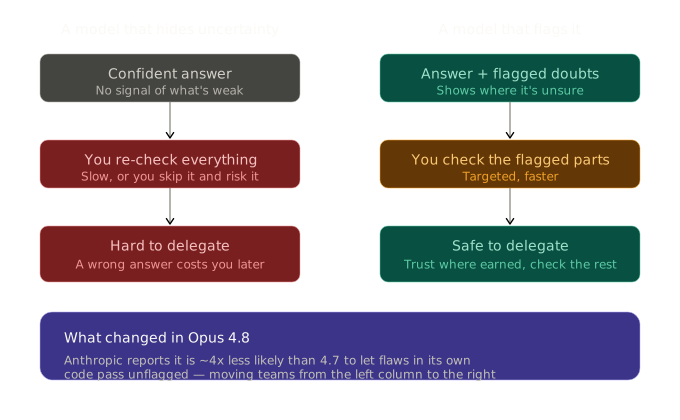
It's more honest about its own work. This is the change I'd weight most heavily for business use. A persistent problem with AI models is that they jump to conclusions and confidently claim progress on thin evidence. Anthropic reports that 4.8 is roughly four times less likely than its predecessor to let flaws in its own code slip by unflagged, and is more likely to surface uncertainty rather than paper over it. Early testers describe it as having sharper judgment on agentic tasks, asking better questions and pushing back when a plan doesn't hold up.
It handles bigger jobs. For developers, there's a new "dynamic workflows" feature in Claude Code (on Enterprise, Team, and Max plans) that lets the model plan a large task, run many subagents in parallel, and verify its own output before reporting back, big enough to handle codebase-scale migrations.
For coding, agentic work, reasoning, and knowledge-work tasks, the benchmark scores tick up across the board versus 4.7. The gains are real but incremental. The reliability and honesty improvements are what change how it feels to delegate to.
Why "more honest" is the feature that matters for business
Most discussion of model upgrades fixates on capability. For a business, the limiting factor is rarely raw capability. It's trust. The question that decides whether AI saves you time or quietly costs you more is: can I act on this output without checking every line myself?
A model that confidently hands you a flawed analysis is worse than a slow one, because the cost lands later, after you've already used the work. A model that says "I'm not certain about this part, here's why" lets you target your review where it counts. That's the practical meaning of the honesty gains in 4.8. It shifts the model from something you supervise constantly toward something you can delegate to and spot-check.
This is the version where "AI assistant" starts to mean a collaborator that tells you when it's unsure, rather than a fast intern who never admits a gap.
How to put it to work, by team
Marketing and content. Use the effort control deliberately. Draft and ideate on a lower setting for speed, then switch to high effort for the work that has to be right: positioning, a sales page, a board-facing summary. One tester who writes for a living noted 4.8 holds voice and style direction across a long session better than before, which matters if you're producing a lot of copy in a consistent brand voice.
Analysis and finance. The honesty gains show up most here. An investment associate testing the model reported its biggest differentiator was proactively flagging issues with the inputs and outputs of an analysis, the kind of thing other models leave for you to catch. If your team runs financial models, market analysis, or due diligence, lean on this: explicitly ask the model to flag its assumptions and weak points.
Operations and knowledge work. Opus 4.8 is built to carry context across long, multi-step projects and produce polished spreadsheets, slides, and documents. For recurring deliverables, monthly reports, client decks, this is where the consistency pays off.
Engineering. If you're on Claude Code, the dynamic workflows feature is the headline. Pair it with the model's improved tendency to catch its own mistakes for large refactors and migrations that previously needed heavy human oversight.
Freebie
Here's a prompt you can copy and use today. It's built to pull out the honesty and judgment that make 4.8 useful for real work, instead of getting a confident answer you have to second-guess. Paste it, fill in the brackets, and go.
The catch worth naming
In regular mode, Opus 4.8 is still among the more expensive frontier models. It's priced as a premium tool that earns its keep on hard, high-stakes tasks, not as the cheapest option for every routine query. The smart move is to match the model to the work: use Opus for the tasks where judgment and reliability are worth paying for, and lighter, cheaper models for the high-volume routine stuff. The effort control gives you a second dial on the same idea.
The bottom line
Don't think of Opus 4.8 as a flashy new capability to chase. Think of it as the version where the model got more trustworthy, more controllable, and, in fast mode, cheaper to run at scale. For a business, those are the boring improvements that actually move the needle, because they decide how much real work you can safely hand off.
The best way to find out what it's worth to you is to take one task you currently don't trust AI with, the analysis you always double-check, the report you always rewrite, and run it through 4.8 on high effort. Ask it to flag where it's uncertain. See whether the output earns your trust.
Need this in production?
We build voice AI agents and back-office automations for Romanian businesses. Live in 7 days.